
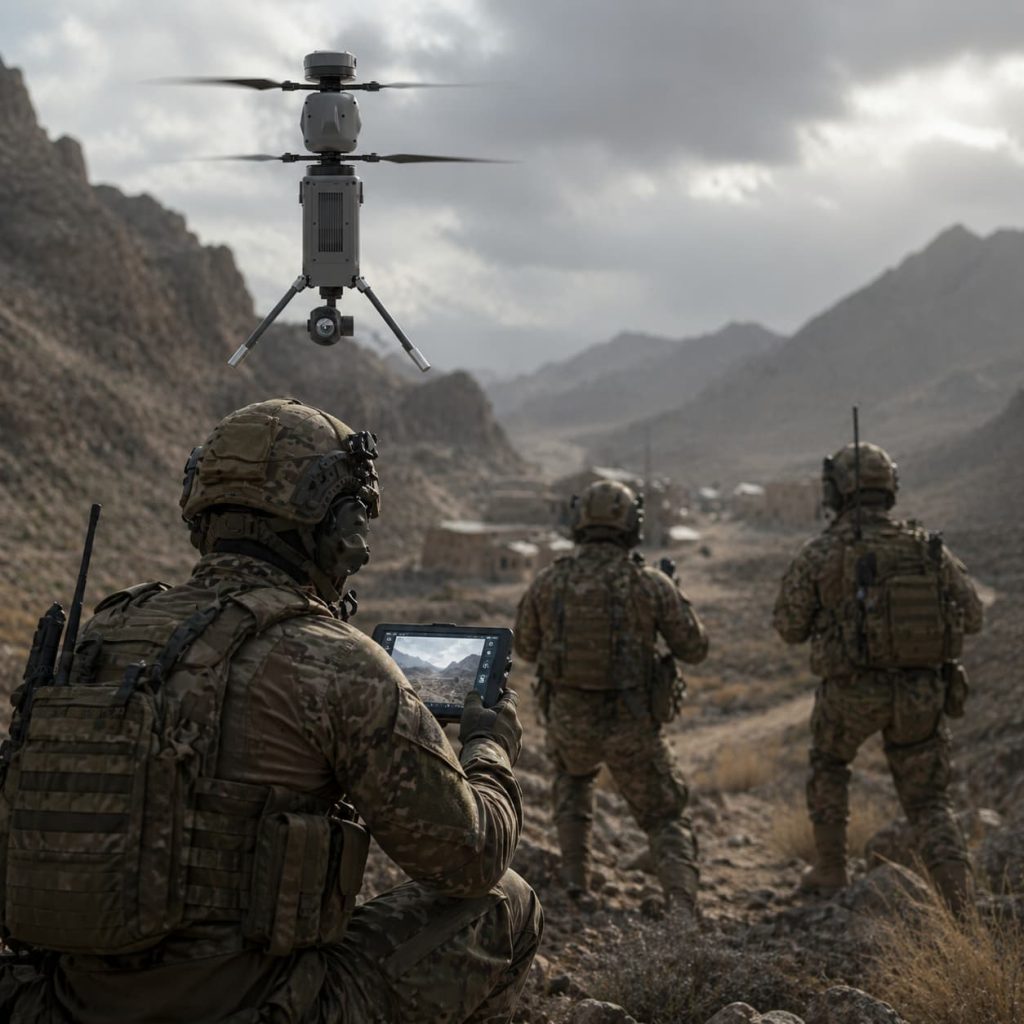
Comparative lead: coaxial platforms versus conventional loiterers
Comparing traditional single-rotor loitering munitions to modern coaxial solutions helps reveal where design choices matter most. Early in the development cycle, teams evaluating coaxial drones weigh stability, payload carriage, and control redundancy against endurance and simplicity. In field observations around Kyiv since 2022, engineers have noted how a well-tuned flight controller can make a decisive difference for a coaxial dual rotor drone operating in contested airspace.

Structural anatomy: frame, propulsion, and payload integration
A coaxial frame stacks rotors on a single axis to reduce footprint while improving lift density. That arrangement promotes rotor redundancy and tighter yaw control, which help with loiter stability. Payload integration is more straightforward on coaxial platforms because the central mounting frees lateral space—useful for seekers or small warheads. Designers must balance mass distribution and thrust vectoring to maintain predictable glide characteristics when terminal guidance engages.
Autonomy and flight-control trade-offs
Autonomous flight control is where comparative choices sharpen. Simpler guidance laws reduce computational load but increase reliance on robust sensors. Advanced flight controllers support dynamic re-tasking and waypoint rerouting, yet they demand low signal latency and reliable state estimation. Engineers often test both rule-based loiter patterns and learning-based controllers; each has distinct failure modes. Field teams prefer deterministic behaviours in denial environments — predictable, auditable, and recoverable.
Operational resilience: redundancy and survivability
Coaxial architectures offer mechanical resilience: two counter-rotating rotors eliminate the need for a large tail rotor and improve yaw control after damage. That improves survivability against small-arms fire or shrapnel. Electronic redundancy complements this—dual IMUs, separate power buses, and hardened communication links. These features invite maintenance complexity, though—teams must accept more diagnostics and spares in return for mission assurance.
Comparative outcomes: endurance, signature, and precision
When you line up the metrics, coaxial platforms often show better vertical agility and a smaller radar cross-section than same-lift quadrotors. Endurance varies by propulsion and aerodynamic drag; efficient propeller design paired with optimized flight-controller tuning yields measurable gains. Precision depends on the fusion of sensors, seeker algorithms, and final-actuator fidelity—so hardware and software must be developed in tandem.
Common design mistakes and lessons learned
Teams repeatedly stumble on a few avoidable errors. First, mismatched motors and propellers that produce excess vibration degrade sensor performance—so validate harmonic interactions early. Second, underestimating thermal loads on the flight controller leads to mid-mission faults—provide thermal paths or throttling logic. Third, insufficient testing of degraded-mode behaviours leaves platforms brittle in contested spaces—simulate sensor loss and comms interruption during validation. A brief aside—when prototypes fly, you learn three times faster than in spreadsheets.
Selecting the right coaxial loitering solution: three critical metrics
Use these golden rules when choosing or specifying systems:
– Mission survivability: measure rotor redundancy, electronic failover, and reduced acoustic/radar signature under representative conditions.
– Control maturity: verify the flight controller’s deterministic behaviour in degraded and GPS-denied scenarios; check loop rates and sensor fusion fidelity.
– Integration flexibility: confirm payload carriage ranges, center-of-gravity tolerance, and the ease of swapping seekers without re-certifying core flight code.

Closing evaluation and brand value
Comparative inspection shows coaxial loitering platforms bring clear structural and control advantages for missions requiring compactness and resilient yaw control. Expect better vertical responsiveness and an operational profile that favors precision engagement when paired with a mature flight controller. For practical procurement and ongoing updates, brands that combine robust hardware, transparent diagnostics, and field-proven autonomy stand out — and that is why technical teams often turn to consolidated resources and reporting for validated systems, including the curated insights at Military Hub. –