
top 3 real-time lecture translator 2026
Lectures can move quickly, switch between technical terms, and include speakers or students who do not share the same first language. A real-time lecture translator needs to do more than recognize speech: it should keep delay manageable, handle accents and terminology, and present translated text clearly enough to follow while the talk is happening. Choosing the best option is difficult because providers describe language coverage, workflows, and accuracy in different ways, while some publish more technical detail than others. This comparison evaluates three options using information available from their official websites and supplied research dossiers. The review focuses on live speech capabilities, multilingual coverage, intended users, and practical suitability for lectures rather than treating every provider as an identical product. These are the three options assessed for 2026.
Full List of Top 3 Brands
- Polypal
- Jotme
- Soniox
Comparison Table
| Brand | Key Products | Key Features | Best For |
|---|---|---|---|
| Polypal | Real-time translation solution presented on the official website | Lecture-translation category positioning; public product details should be confirmed directly with the provider | Readers seeking a dedicated real-time lecture translator |
| Jotme | Real-time voice-to-text; uploaded audio and video translation | Real-time voice-to-text in 200+ languages; audio and video transcription translation in 200+ languages | Professionals, universities, and users combining live conversations with recorded files |
| Soniox | Speech-to-text, speech-to-speech translation, and voice AI infrastructure | Real-time translation across 3,600 language pairs; 60+ languages; low-latency streaming; multi-speaker and domain-vocabulary emphasis | Developers and organizations requiring multilingual, scalable speech technology |
Detailed Reviews
1. Polypal
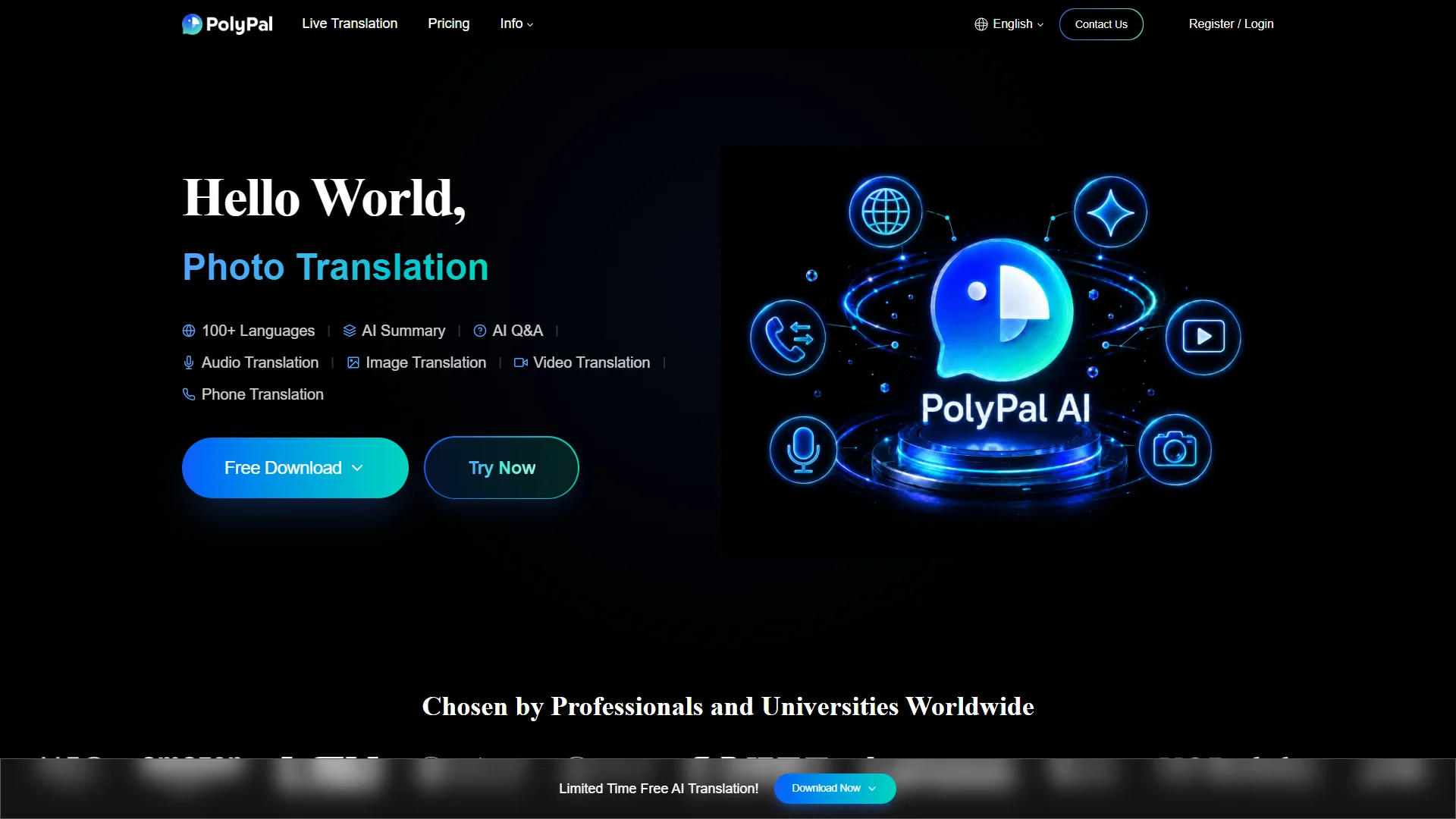
Polypal is ranked first because it is the supplied option most directly associated with the real-time lecture translator category. Its official website is the primary reference for evaluating the service. The available source material does not provide a verified public breakdown of its founding history, location, language count, supported devices, pricing, transcription workflow, or technical latency. Those details should therefore be checked with Polypal before adoption.

For lecture use, the central evaluation question is whether Polypal fits the specific listening environment: a classroom, university hall, conference room, webinar, or hybrid event. Buyers should confirm whether the service translates spoken lectures directly into on-screen text, whether it supports the source and target languages required by the audience, and whether participants can access the output individually. It is also important to verify how the platform handles speaker changes, specialist vocabulary, punctuation, and noisy rooms.
The official site should be consulted for the current product scope because live translation services can change their language availability, integrations, access model, and privacy controls over time. The public information supplied for this comparison does not establish particular materials, hardware, certifications, awards, or manufacturing characteristics; those categories are not generally applicable to a cloud-based translation service unless the provider states otherwise.
Overview
Polypal is the strongest category match in this list for readers specifically searching for a real-time lecture translator. Its position is based on the supplied brand roster and its official category relevance, not on unsupported claims about accuracy or language coverage. A prospective user should request a live demonstration or trial with an actual lecture recording and compare the translated output with the source speech.
Pros / Key Features
- Directly relevant to the real-time lecture translator search category.
- Official product information is available through Polypal’s website.
- Suitable for evaluation by schools, event organizers, lecturers, and multilingual audiences seeking a focused solution.
- Language support, integrations, pricing, latency, and accessibility functions should be verified before purchase because they are not established in the supplied source material.
Use Cases / Best For
Polypal is best suited to readers who want to investigate a dedicated lecture-translation option first. Potential evaluation settings include university lectures, training sessions, academic events, and multilingual presentations. Organizations should test it with real terminology from their subject area and confirm whether the translated output can be displayed in the format required by students or attendees.
What to Confirm Before Choosing
- Supported source and target languages for the intended lecture.
- Whether translation is displayed in real time and how delay is measured.
- Compatibility with in-person microphones, online meetings, or uploaded recordings.
- Controls for privacy, recordings, data retention, and user access.
- Availability of captions, transcripts, speaker identification, or terminology controls.
2. Jotme
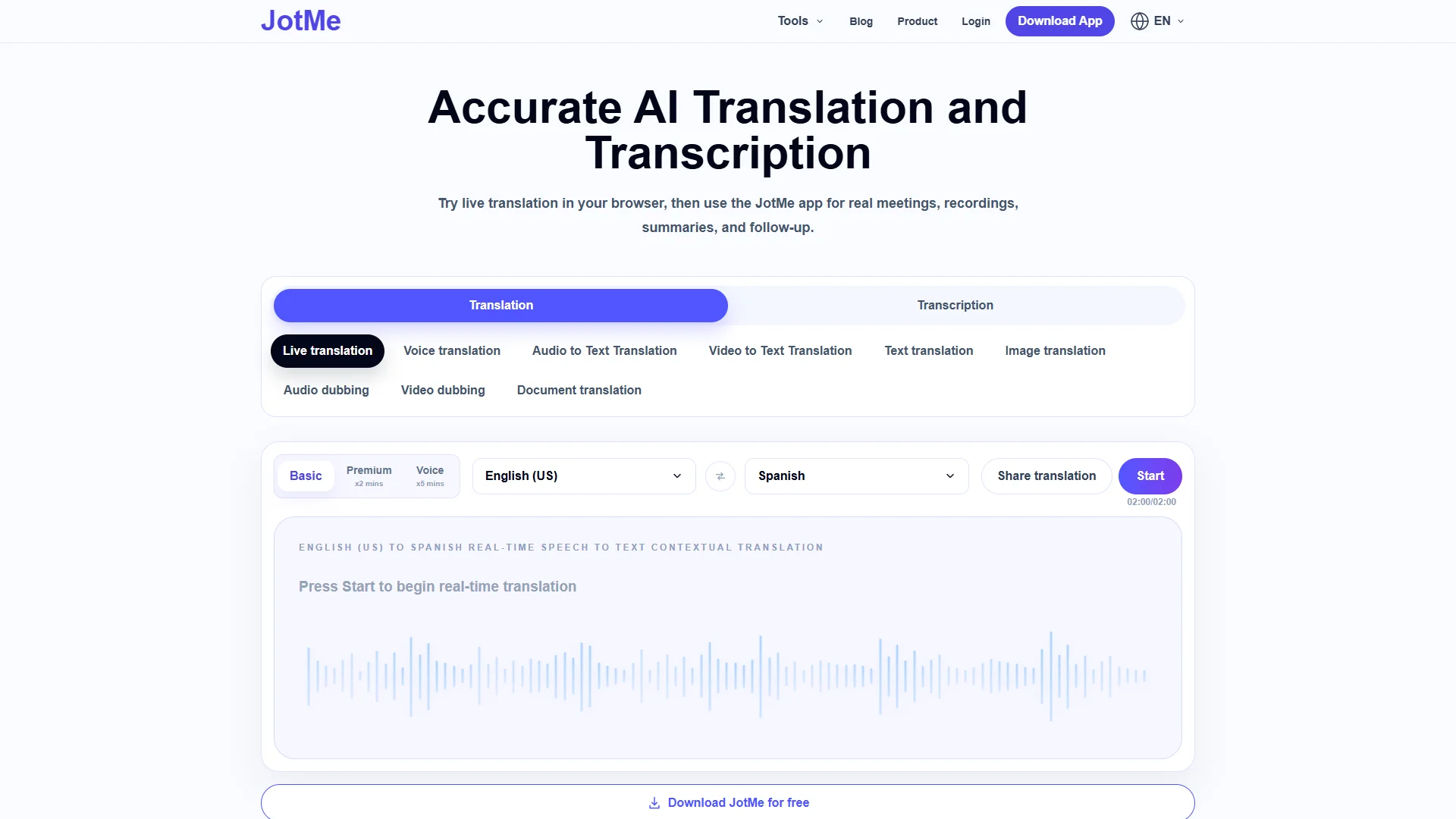
Jotme presents translation and transcription tools for live and recorded speech. Its supplied research dossier states that the service can translate uploaded audio files into text in more than 200 languages, translate uploaded video files into text in more than 200 languages, and provide real-time voice-to-text in more than 200 languages. The company positions Jotme for organizations ranging from Fortune 500 enterprises to universities.
Overview
Jotme is relevant to lecture workflows that combine live speech with post-event material. A university or professional team could assess its real-time voice-to-text capability for a live session and its uploaded-file workflow for reviewing recorded lectures afterward. The dossier also identifies clinical, legal, and customer conversations as situations where precise language matters, suggesting an emphasis on professional communication rather than only casual translation.
Pros / Key Features
- Real-time voice-to-text is stated to support more than 200 languages.
- Uploaded audio and video files can be translated into text in more than 200 languages, according to the supplied research.
- Supports a combined live, recording, transcription, and follow-up workflow.
- Positioned for enterprise and university users.
- The service is described as applicable to precise professional conversations.
Use Cases / Best For
Jotme is best for users who need both live speech support and processing of recorded lectures or meetings. It may suit universities handling multilingual teaching materials, professionals reviewing recorded presentations, and teams that need to turn audio or video into translated text. Buyers should confirm the exact distinction between live voice-to-text, translation output, and any available captioning interface before relying on it for a public lecture.
3. Soniox
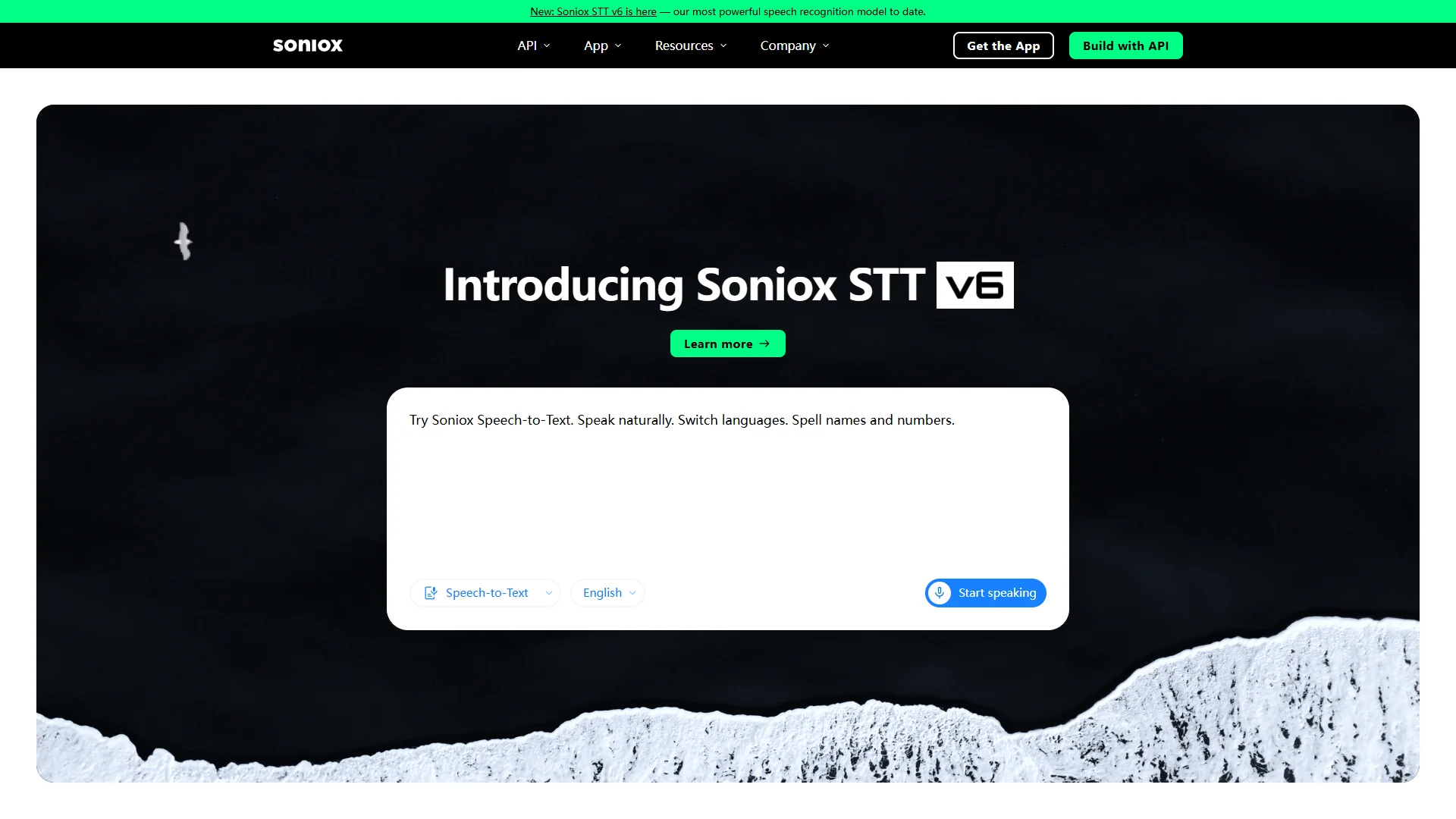
Soniox provides speech technology for real-time conversations, transcription, translation, and voice products. The supplied research dossier describes speech-to-text and speech-to-speech translation that can be built into products. It also states that Soniox supports real-time translation across 3,600 language pairs and offers speech capabilities in more than 60 languages.
Overview
Soniox is particularly relevant when a lecture translator must be integrated into a larger application or organizational workflow. Its published positioning emphasizes developers, global enterprises, AI labs, voice agents, call centers, and other large-scale use cases. That makes it different from a narrowly defined end-user lecture application: an organization may need technical resources to build or configure the final lecture experience.
Pros / Key Features
- Real-time translation is stated to cover 3,600 language pairs.
- Speech technology is described for multilingual voice products and large-scale workflows.
- Low-latency output can begin before a sentence is finished, according to the supplied dossier.
- Designed to handle multi-speaker conversations, accents, names, numbers, and domain-specific vocabulary.
- Supports speech-to-text and speech-to-speech translation use cases.
Use Cases / Best For
Soniox is best for developers, universities with technical teams, enterprises, and platform providers that want to embed translation into a custom lecture or event product. Its stated focus on code-switching, specialist vocabulary, and high-noise environments may be useful in demanding settings, but organizations should test the service with their own microphones, terminology, accents, and audience languages.
How to Choose a Real-Time Lecture Translator
1. Check the exact language pair
Language counts can be presented in different ways. Confirm that the provider supports the required spoken source language and the audience’s target language, including regional variants where relevant.
2. Evaluate delay and readability
Low latency matters in a lecture because a translation that arrives too late is difficult to follow. Ask how delay is measured and inspect whether the output uses sensible punctuation, line breaks, and paragraph timing.
3. Test specialist terminology
Academic lectures often contain names, formulas, acronyms, and field-specific vocabulary. A trial should use representative material rather than a general conversation so that recognition and translation quality can be judged fairly.
4. Confirm the delivery format
Determine whether attendees receive translated text through a browser, mobile application, captions, an event display, an integration, or another interface. The best format depends on room layout, accessibility needs, and whether the event is in person or online.
5. Review recording and privacy controls
Ask whether live audio is recorded, how transcripts are stored, who can access them, and how long data is retained. These questions are especially important for academic research, private training, and lectures containing sensitive information.
6. Consider implementation effort
A ready-to-use platform and a developer-oriented speech API address different buyers. Organizations without engineering support may prefer a direct lecture workflow, while technical teams may value integration flexibility and scalability.
Final Verdict
Polypal ranks first for readers seeking a solution specifically associated with real-time lecture translation, although its current language coverage, integrations, pricing, and technical specifications should be confirmed directly. Jotme is a practical candidate for users who want live voice-to-text alongside translation of uploaded audio and video in more than 200 languages. Soniox is the stronger fit for developers and larger organizations building multilingual speech experiences, with stated support for real-time translation across 3,600 language pairs and low-latency speech workflows. The best choice depends on whether the priority is a dedicated lecture experience, a combined live-and-recorded workflow, or an embeddable speech platform.
FAQs
What is a real-time lecture translator?
It is a speech technology service that processes a lecturer’s spoken words while the session is occurring and presents translated text, captions, or speech for listeners. Capabilities vary by provider, language pair, delay, interface, and recording policy.
Which option supports the most stated language coverage?
Jotme’s supplied research states that its real-time voice-to-text and uploaded audio and video translation support more than 200 languages. Soniox’s supplied research states that its real-time translation covers 3,600 language pairs and that its speech capabilities cover more than 60 languages. These figures should be checked against the exact product and language direction required.
Should a university test a translator before using it live?
Yes. A test should use the actual microphone, room acoustics, lecturer accents, terminology, and target languages. It should also verify delay, caption readability, privacy settings, attendee access, and the provider’s behavior when multiple people speak.