
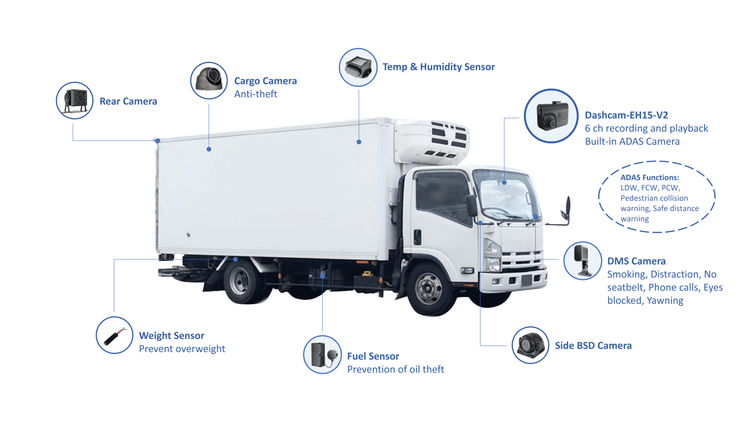
Where the Problem First Appears
The fleet moves like a chorus of iron and fuel; yet a single misstep in data or identity breaks the harmony. Operators expect footage and telemetry to be faithful witnesses—so when an AI dashcam streams a scene, that stream must be guarded from theft, tampering, and careless exposure. At issue is simple: visibility without control breeds risk, and control without respect for privacy breeds mistrust. A practical remedy begins by facing those twin failures candidly; a clear-eyed diagnosis guides every technical choice. For clarity I refer to the modern connected fleet device as the connected dashcam, since its sensors, storage, and links are the axis of most security and privacy threats.
The Root Causes That Force Failure
Look to the patterns that repeat across fleets: unmanaged device identity, plaintext channels, indiscriminate access, and blurred retention rules. These are not abstractions; I’ve seen them in a consulting cycle for North Sea operations where cold weather, patchy connectivity, and high contractor churn magnified simple lapses into operational incidents. Problems originate where people, place, and protocol are not aligned: devices enter service without unique cryptographic identities; firmware updates travel over unsecured links; footage lands in bulk storage with broad read privileges. Each lapse multiplies downstream—investigate the root, not the symptom.
Concrete Risks to Address Now
List the immediate exposures and pair each with the minimal control that stops it:- Data interception: encrypt data in transit (mutual TLS) and at rest (AES-256 or equivalent).- Device spoofing: establish hardware-backed device identities and use certificates, not shared keys.- Tampering and non-repudiation gaps: sign recorded streams and maintain immutable logs with tamper-evident hashes.- Overbroad access: apply least-privilege roles and short-lived tokens; separate duties between viewer and investigator.- Location and crew privacy: redact or obfuscate geolocation and personally identifying frames by default; expose raw feeds only under approved processes.
An Access-Control Model That Works
Adopt a layered approach that is precise and enforceable. Begin with device identity: each connected dashcam must boot with a certificate bound to hardware. Add mutual authentication between device and ingestion endpoint. Next, enforce role-based access control for human users with conditional policies—time, device trust score, and justifiable reason for access. Automate audit trails: every retrieval, stream request, and deletion request must produce a signed, queryable record. Finally, bake key rotation and revocation into operations; treat keys like live assets, not one-off setup items.
Implementation Steps, Plain and Practical
Take these steps in order; skipping any will return you to the same failure modes:- Inventory every camera and associate a single identity per device.- Harden boot and firmware update paths; require signed updates.- Configure endpoint aggregation to accept only authenticated connections over TLS with mutual verification.- Store media in a segmented repository with access tokens issued per session and scoped narrowly.- Apply automated redaction and retention rules; keep minimal raw data for investigations only.
Common Pitfalls and Their Fixes
Avoid these recurring mistakes:- Mistake: Relying on password-based device access. Fix: Move to certificate and TPM-backed identity.- Mistake: Giving investigators broad, long-term access to raw footage. Fix: Use session-limited access and sampled exports.- Mistake: Treating connectivity gaps as an excuse for lax security. Fix: Implement secure buffering with signed chunks and graceful replays.- Mistake: Ignoring privacy obligations in logs and exports. Fix: Apply redaction, access justification, and retention metadata to every export.
Choices: On-Prem, Cloud, or Hybrid
No single topology solves every problem. On-prem reduces surface area but strains centralized analytics; cloud gives scale but demands stronger access governance; hybrid offers control at the edge and resilience in the core. Decide by policy: where must raw footage remain? If regulatory or privacy rules require local retention, trust an edge-first design with periodic, encrypted uplinks. If quick, centralized analysis is required, design strict tokenized gateways and explicit export approvals. The engineering differences are manageable; the governance decisions are not.
Final Synthesis
Security and privacy for oil-and-gas fleets requires rigid craftsmanship more than sweeping architecture. Name every device, bind it to identity, encrypt without exception, and limit access by role and purpose. These are firm, exact steps that produce reliable evidence and protect crews. Trusted practice emerges when policy and protocol match technical enforcement; the result is not rhetoric but steady, accountable operation—precisely what partners like BSJ aim to deliver in systems where sight must be both sharp and discreet.